Eavestrough Installation and Repair in Cambridge, Ontario
Seamless aluminum trough for century homes and steep-roofed houses across Galt, Preston and Hespeler, with the rotten wood fascia dealt with first and the downspouts kept off the neighbour and the sidewalk as Cambridge's property standards require.
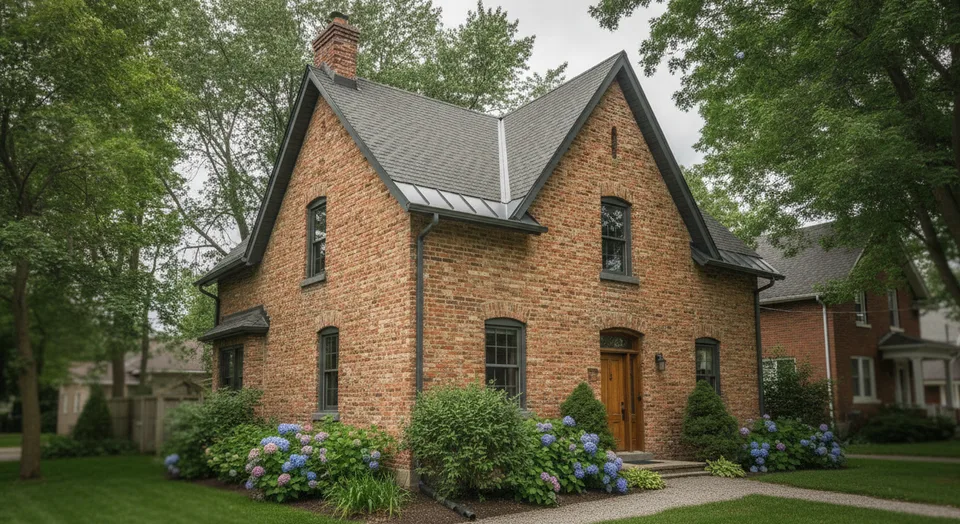
Cambridge is three old towns with three generations of roof edge. The century houses of Galt and Preston — yellow brick and fieldstone, steep gables, deep eaves — carry wood fascia and wood soffit that have been fed water by a century of overflowing troughs, and the rot is usually worse than the trough. In Hespeler the storey-and-a-halfs and later houses around the mill have the steep roof pitches that shed snow in a single slide and take the eavestrough with it. The newer subdivisions on the edges of all three have the ordinary builder-grade problems of light trough and too few downspouts. What ties them together is where the water ends up, and on that Cambridge is unusually clear: the City's property standards by-law says roof drainage may not be discharged onto a walkway, stair, sidewalk or entranceway, or directly onto a neighbouring property, and every downspout must carry water away from the building. On a Galt lot where the house sits a metre from the sidewalk and two metres from the next house, that rule writes most of the downspout plan before anyone gets on a ladder. The site visit works out the rest.
Eavestrough Work We Take On in Cambridge
Seamless aluminum installation and replacement, rotten fascia and soffit repair, re-sloping and resealing of existing runs, ice and snow damage, and downspouts placed to Cambridge's property standards. Leaf guards go on with a new install. A run is cleared as part of fixing it, though cleaning alone is not what this service is for.
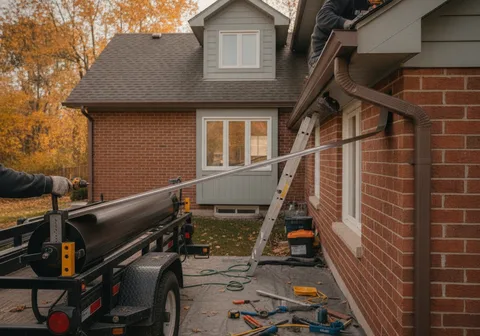
Eavestrough Installation & Replacement
Trough formed on site in one piece per run, sized 5-inch or 6-inch for the roof it serves, hung on screwed hangers into sound fascia, with leaf guards fitted at the same time where the trees justify them.
Learn more →
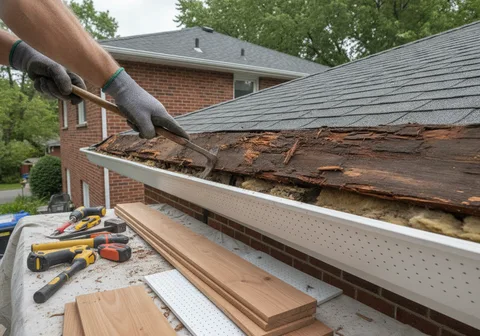
Fascia & Soffit Rot Repair
Probing and replacing the wood fascia and soffit that a century of overflowing troughs has rotted on Galt and Preston houses, capping or repainting what is sound, and venting closed eaves before the new trough is hung.
Learn more →
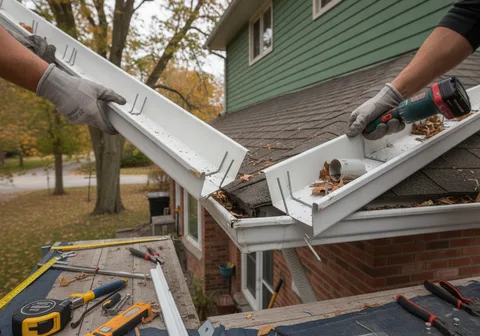
Eavestrough Repair & Re-sloping
Re-pitching runs that hold water, replacing hangers that have let go, resealing or replacing seams, mitres and end caps, and fixing the drip edge when water is getting behind the trough rather than into it.
Learn more →
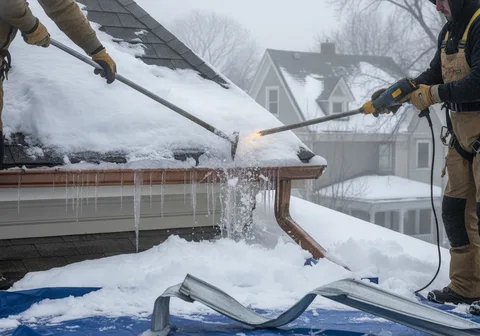
Ice & Snow Damage Repair
Re-hanging and replacing trough that a winter bent, loaded with ice or tore off the fascia, with the hanger spacing, pitch and attic venting looked at so the same thing does not happen next March.
Learn more →
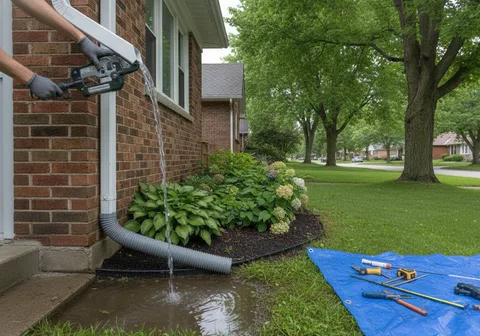
Downspout Installation & Discharge
Adding outlets to runs that have too few, moving downspouts off the sidewalk and the neighbour's side, and fitting extensions so the water goes away from the building as Cambridge's property standards by-law requires.
Learn more →
Eavestrough in Cambridge: The By-law, the Old Wood and the Steep Roofs
What Cambridge's property standards by-law says about roof water. Cambridge is one of the few municipalities in the Region whose Property Standards By-law 26-021 speaks directly to eavestroughs. Section 4.8 says no roof drainage, sump pump or other device meant to discharge water may discharge on an entranceway, walkway, stair or sidewalk, or directly onto neighbouring property. Section 4.9 requires every downspout to be maintained so it directs water away from buildings and structures. Section 4.10 requires yards to be graded so storm water does not pond excessively on the lot or on adjacent premises, and section 5.11 requires every eavestrough, roof gutter and downspout to be kept in good repair and weathertight. The City's by-law inquiries page puts it in plain words: water can be drained from eavestroughs, downspouts or sump lines, but cannot be directed at a neighbouring property or onto an entranceway, walkway, stair or sidewalk. A dripping, sagging trough is therefore not just a nuisance in Cambridge; it is a property standards matter that a neighbour can report.
Galt and Preston: the fascia is the job. The brick and stone houses of old Galt, around Dickson Hill and the streets rising from the Grand, and of Preston along King Street and the Speed, were built with deep overhangs, decorative wood fascia and bead-board or plank soffit. That woodwork has outlived several generations of trough, and every one of those troughs overflowed at the back at some point and soaked it. The result is that an eavestrough call on a century house is usually a carpentry call first: soft fascia at the corners and below the old outlets, soffit boards cupped and split, and sometimes rafter tails gone at the ends. A new trough screwed into that holds for a winter or two. The honest sequence is to take the old run down, probe the wood along its whole length, replace what is rotten, cap or paint what is sound, and only then hang the new system. Where a house sits in one of Cambridge's three Heritage Conservation Districts — Blair Village, Dickson Hill and Main Street — or is individually designated, changes to the visible roof edge may need the City's heritage staff involved, and heritageinfo@cambridge.ca is the place to ask before the old profile is altered.
Hespeler and the steep roofs. Hespeler's older housing around the mill district and up the hill from Queen Street runs to steep pitches — storey-and-a-halfs, Gothic Revival gables, later wartime houses with sharp roofs — and steep roofs do two things to an eavestrough. Water comes off them fast and overshoots a trough that is set too low or too far out, so the trough position relative to the shingle line matters more than on a bungalow. And snow releases in a slide rather than melting in place; a winter's accumulation letting go at once will bend the front lip of a light trough or tear a spiked run off the fascia outright. The answer is partly specification — heavier gauge, screwed hidden hangers at close spacing, sometimes a 6-inch trough to catch the faster flow — and partly honesty about ice. Where a steep, poorly vented roof builds ice at the eave every winter, the eavestrough is the victim, not the cause, and the fix that lasts involves attic ventilation and insulation as much as the trough.
The stormwater fee, the Region's sewer by-law, and what you can and cannot claim. Since July 1, 2025, Cambridge has billed a Stormwater Utility Fee on the water bill, with flat residential rates set by lot size. Unlike some neighbouring cities, Cambridge's stormwater fee credit program is open only to non-residential properties, so a homeowner should not expect a bill reduction for a rain barrel or a disconnected downspout. The City does ask that downspouts be directed to a rain garden or grass rather than onto hard surfaces such as the driveway, and that is good practice regardless. Across the Region, the Region of Waterloo Sewer Use By-law 21-036 prohibits storm water and water from roof drainage from entering a sanitary sewer. On the old streets of Galt and Preston that matters, because some houses still have a downspout running into a cast iron or clay standpipe at grade whose destination nobody remembers. Before a new downspout is connected to one, it gets traced; if it cannot be, it is capped and the water is released above grade.
Collected water is yours to manage, and the Code wants it away from the wall. Ontario's guidance on surface water and drainage disputes separates rain that simply runs across your land, which the courts have not treated as grounds for a lawsuit, from water you have collected — and it names eavestroughs and downspouts as the example. Collected water carries an obligation to release it without causing problems downstream, and damage from it can be grounds for legal action. Layered on top is Ontario's Building Code, now the 2024 Compendium and enforced by Cambridge's building officials, whose intent for a dwelling is that the ground falls away from the foundation and roof water is kept from it. Replacing eavestrough like for like does not normally need a permit; regrading a yard or rebuilding a rotten roof edge structurally might, and on those the City's building division is the authority, not this site.
Roof-drainage and downspout rules are sections 4.8, 4.9, 4.10 and 5.11 of the City of Cambridge Property Standards By-law 26-021, summarised on the City's common by-law inquiries page. Stormwater Utility Fee details, the non-residential-only credit program and the request to direct downspouts to grass or a rain garden are from the City's stormwater page. Cambridge's three Heritage Conservation Districts are listed on the City's history and heritage page. The prohibition on roof and storm water entering a sanitary sewer is Part III, s. 4(8) of the Region of Waterloo Sewer Use By-law 21-036. The distinction between collected and uncollected surface water is from Ontario's surface water and drainage disputes page, and building drainage requirements are set by Ontario's Building Code. Confirm anything specific to your property, including heritage status, with the City of Cambridge before work begins.
Frequently Asked Questions
My fascia is rotten behind the eavestrough. Can you fix that too?
Yes, and on a Galt or Preston century home it is usually the larger half of the job. The old trough comes down, the wood is probed end to end, rotten fascia and soffit boards are replaced, sound wood is capped in aluminum or left painted if the house calls for it, and only then is the new trough hung. Rot that has reached the rafter tails is flagged before anything is covered.
Where am I allowed to drain my downspouts in Cambridge?
Away from the building, onto your own lot, and never onto an entranceway, walkway, stair or sidewalk or directly onto a neighbouring property — that is the City's Property Standards By-law 26-021. The City asks that the water land on grass or a rain garden rather than the driveway, and roof water may not enter the sanitary sewer under the Region's by-law.
Do I need 6-inch eavestrough on a steep roof?
Often, yes. A steep roof delivers water to the trough faster and a 6-inch K-style trough with 3-by-4 downspouts catches it where a 5-inch can overshoot. Metal roofs and long single-outlet runs point the same way. On a typical bungalow with outlets at both ends, 5-inch is the standard and is enough.
Does a heritage house need permission to change the eavestrough?
If the house is in the Blair Village, Dickson Hill or Main Street Heritage Conservation District, or is individually designated, changes to the visible roof edge may need the City's heritage staff involved. Like-for-like replacement is usually straightforward, but ask heritageinfo@cambridge.ca before altering a wood fascia profile or adding aluminum capping to a designated facade.
Can you repair a trough that snow pulled off the house?
Yes. A run torn off by a slide is re-hung on new screwed hangers at the correct pitch, bent sections are replaced, and the hanger spacing is tightened below the roof plane that sheds. If the real cause is ice building at a poorly vented eave, we tell you, because no trough repair fixes that on its own.
Do you install leaf guards?
With a new installation, yes. The guard is matched to the trough, the outlets and pitch are sized for it, and expectations are set honestly: under the old maples of Galt and Preston a guard cuts the work considerably but does not make the trough invisible for ever. We do not put guards over a failing old trough.
Will I get a stormwater credit for a rain barrel in Cambridge?
Not as a homeowner. Cambridge's stormwater fee credit program is for non-residential properties only. A rain barrel is still worth having for the garden, and if you want one we position the downspout so it sits level and overflows onto grass rather than back at the foundation.
Ready to Get Started?
Call 289-672-2697 or send the form for a written quote for eavestrough in Cambridge.